Guide
Fra Angelico's Annunciation in Cortona: History and What to See
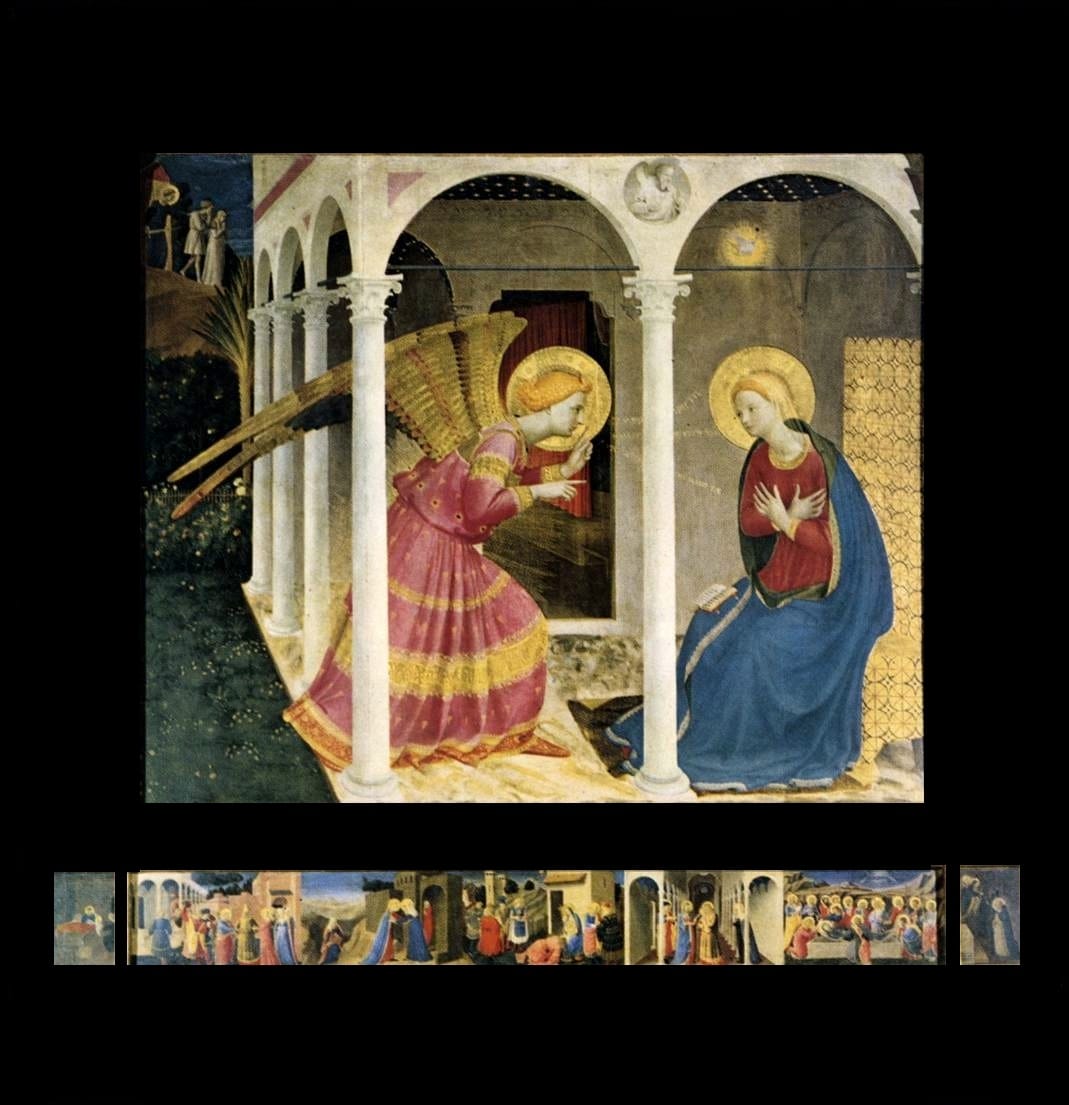
If the angel Gabriel got to his feet, he’d be as tall as the columns holding up the portico. Fra Angelico painted him oversized on purpose. Worshippers sat a long way from the altar, and the enlarged figures gave the scene its punch even from the back rows.1 That one detail tells you how to approach the Annunciation that Fra Angelico painted for Cortona: slowly, up close, and knowing where to look.
The Cortona Annunciation is an altarpiece in tempera on panel. Fra Giovanni da Fiesole, better known as Fra Angelico, painted it in the 1430s for the church of San Domenico. Today it hangs in the Museo Diocesano di Cortona, housed in the former church of the Gesù, and it is counted among the finest of his Annunciations.2 What follows is a viewing guide to keep on your phone while you stand in front of the panel, taking it one detail at a time.
The Cortona Annunciation at a glance
| Item | Details |
|---|---|
| Artist | Fra Angelico (Giovanni da Fiesole, born Guido di Pietro; Vicchio, c. 1395 - Rome, 1455) |
| Medium | Tempera on panel |
| Size | 175 × 180 cm (one catalogue entry gives 150 × 180 cm) |
| Date | 1430s (sources range from 1432 to 1438) |
| Painted for | Church of San Domenico, Cortona |
| Where it is now | Museo Diocesano di Cortona, former church of the Gesù |
| Predella | Small panels with scenes from the life of the Virgin and an episode featuring Saint Dominic |
The dates need a little untangling, because the sources disagree. Encyclopaedia Britannica gives 1432-34, the Web Gallery of Art 1433-34, and Finestre sull’Arte around 1434-36. Tuscany’s official tourism portal widens the window to 1434-38, the years the painter spent at the Dominican convent in Cortona.3 The panel was once thought to be the earliest of Fra Angelico’s Annunciations. Scholars now tend to deny it that title, which takes nothing away from it.2
The journey from church to museum has a story of its own. The altarpiece was made for San Domenico and, in the centuries that followed, moved to the church of the Gesù, probably during the French occupation.4 That’s why some sources tie it directly to the Gesù, which is now home to the Museo Diocesano.
The cloth merchant who wanted an Annunciation
The man who paid for the panel was a textile merchant, Giovanni di Cola di Cecco. He belonged to the confraternity of San Domenico in Cortona and held the patronage of the chapel of the Annunziata inside the same Dominican church.2 In other words, he knew his fabrics. It’s hard not to think of him when your eye lands on the brocade behind the Virgin’s seat.
The painter was a Dominican friar. His early work came from commissions tied to the order, and he had started out illuminating manuscripts.1 He lived at the Dominican convent in Cortona until 1438. In those years he painted three works for San Domenico: the Annunciation, a Madonna and Child with four saints, and the fresco in the lunette above the main door.3 So Fra Angelico left Cortona a small cluster of works, all made for the same church.
Seven details to look for in front of the panel
-
The golden words. Step closer to the two figures. Gold letters stream from their mouths, spelling out the exchange from the Gospel of Luke. The angel says “Spiritus Sanctus superveniet in te”, “the Holy Spirit shall come upon thee”. Mary replies “Ecce ancilla Domini, fiat mihi secundum verbum tuum”, “behold the handmaid of the Lord; be it unto me according to thy word”. The angel then closes with “Virtus Altissimi obumbrabit tibi”, “the power of the Highest shall overshadow thee”.2
-
Two figures too big for the loggia. Compare the kneeling angel with the column beside him. Standing up, he’d be as tall as the column that holds up the portico roof. That’s deliberate. By scaling up the main figures, Fra Angelico made them legible to anyone praying at the far end of the nave, and gave the scene real intensity.1
-
The portico and the prophet. The loggia has Corinthian columns and recalls Brunelleschi’s architecture. Look up at the central arch and you’ll find a roundel with the prophet Isaiah, the Old Testament voice who foretold the Messiah’s birth.2 The marble is an off-white, almost earthy, shading towards ochre inside the loggia.
-
The pull towards the top left corner. Follow the colonnade as it recedes. The vanishing lines, one of the earliest uses of linear perspective, lead you up to the top left, where a tiny Expulsion of Adam and Eve from the Garden of Eden is tucked away.1 The story the Annunciation sets out to put right begins there, pushed into a corner your eye reaches last.
-
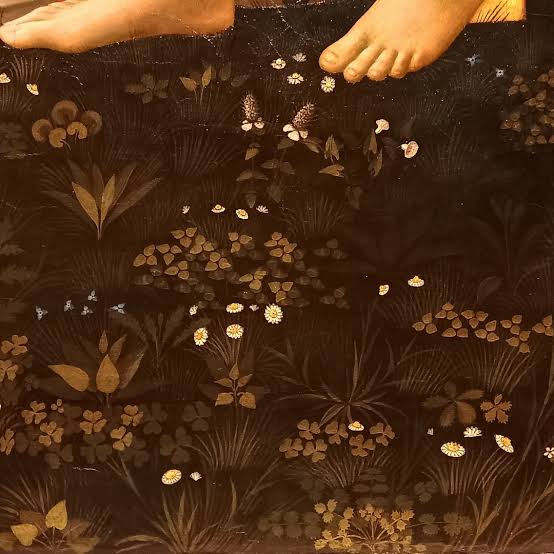
The brocade on the seat. Look at the cloth behind the Virgin. It’s patterned with circles split into eight segments, painted with a miniaturist’s patience.2 The furnishings and robes echo the luxury of the early Renaissance, so anyone walking into the church saw the sacred scene set in their own time, among objects they’d recognise.1
-
The light coming down. Above Mary’s head flies the dove of the Holy Spirit, wrapped in light. Then notice how the gold keeps coming back: in the gleam of the seat, the haloes, the angel’s wings, the ornament. The green of the lawn and the white of the marble belong to the earth, while the gold brings the divine into the scene.2
-
The predella, down below. Drop your gaze to the strip beneath the altarpiece. Finestre sull’Arte identifies the Marriage of the Virgin, the Visitation, the Adoration of the Magi, the Presentation in the Temple and the Dormition.2 The Web Gallery of Art entry counts six small panels instead and, among the 23 × 14 cm scenes, lists the Birth of the Virgin and the scene of the Virgin handing the habit to Saint Dominic, a nod to the painter’s own order.4
Why is it said to hover between Gothic and Renaissance?
Two worlds share this one panel. The receding portico, the carefully worked proportions and the Brunelleschi-style architecture are pure Renaissance. The lavish gold, the painted lettering and the fine detail of the fabrics come from the late Gothic tradition and from manuscript illumination, where Fra Angelico learned his craft.
Art historian Maurizio Calvesi, quoted by Finestre sull’Arte, describes Fra Angelico as a painter who embraced and championed the new Renaissance principles, setting an openly naturalistic vision inside a rigorous perspective framework.2 Tuscany’s official tourism portal compares his Annunciations and sees the influence of Masaccio in the Cortona panel, while the San Giovanni Valdarno version seems closer to Masolino.3
Try looking at it twice. First from a distance, the way 15th-century worshippers did, and let the large figures and the receding portico do their work. Then up close, for the detail you’d expect in an illuminated manuscript. Each distance shows you something different, and Fra Angelico planned for both. His fresh, naturalistic approach would go on to influence another Tuscan, Leonardo da Vinci.1
The panel Annunciations side by side
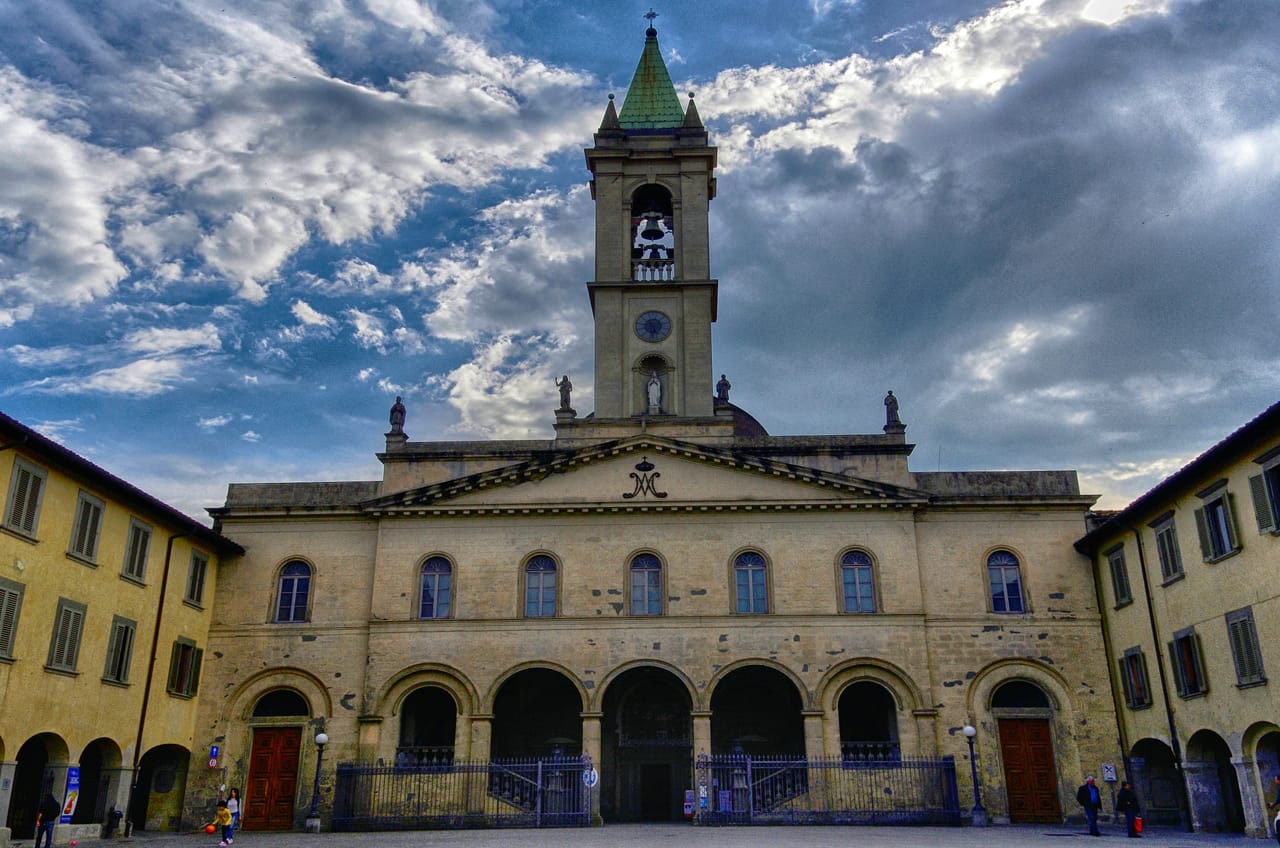
Fra Angelico painted three Annunciations on panel.3 Britannica calls the Cortona version the richest and most beautiful of the three.1 If you’ve already seen the one in San Giovanni Valdarno, or plan to on another day, putting them side by side brings out what makes the Cortona altarpiece special.
The San Giovanni Valdarno panel dates from around 1440 and comes from the Franciscan convent of Montecarlo. It plays warm colours against cool ones, with touches of gold to lift the scene. Behind the arches on the left there’s a garden, a symbol of Mary’s purity, and on the distant hill the Expulsion of Adam and Eve appears again. Here, too, the predella tells five scenes from the life of the Virgin.3
The ingredients are almost the same, yet Cortona feels more monumental. The figures fill the space, the portico’s perspective is sharper, and the Expulsion marks the end of the eye’s journey. This is the Masaccio influence the Tuscan sources talk about. San Giovanni leans instead towards a gentler grace.
Where to see it, plus a Fra Angelico morning walk in Cortona
The Annunciation is on display at the Museo Diocesano di Cortona. You’ll find it in the large room that was once the baptistery of the former church of the Gesù, next to Fra Angelico’s other panel, the Madonna and Child with four saints, also painted for San Domenico.3
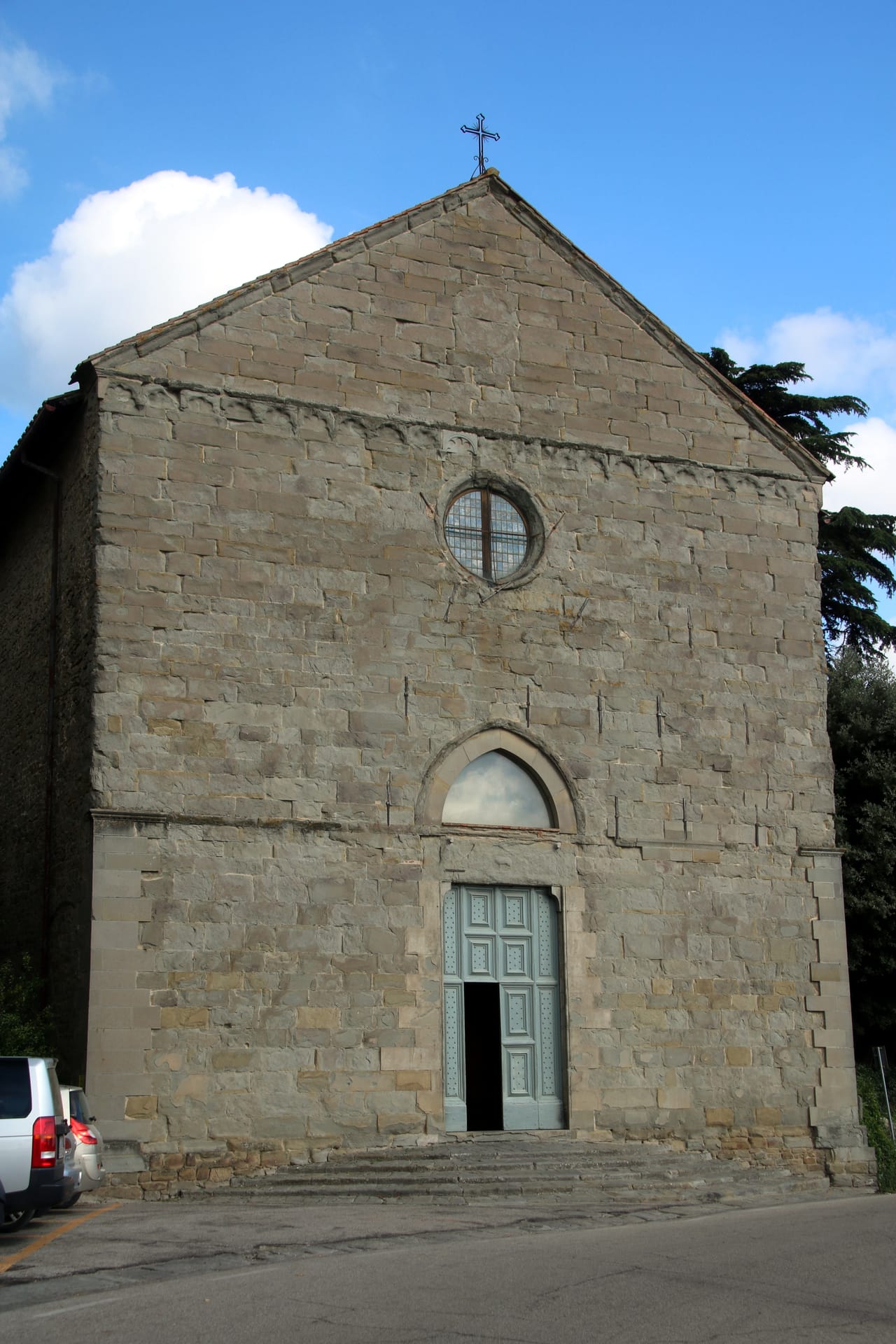
A single morning is enough for a short walk in Fra Angelico’s footsteps. Start at the museum and give the Annunciation the time it deserves, working through the seven details above. Then move on to the Madonna with saints in the same room. Head out and walk over to San Domenico. Above the church’s main door is the lunette the painter frescoed in the same years as the two panels.3 That way you see all three works made for the same building, one after another.
In the afternoon, if you still have the energy, the town has more painters to discover. The works of Luca Signorelli and Gino Severini round off the day nicely. To fit it all together without rushing, you can follow the itinerary for visiting Cortona, or widen your view to the Etruscan walls and the other highlights of Cortona’s art and Etruscan treasures.
After a morning spent with Fra Angelico’s gold, Hotel Villa Santa Margherita is a good place to slow down and let that golden conversation between the angel and Mary sink in.
Sources
Footnotes
-
The Annunciation | History, Description, & Facts | Britannica. britannica.com ↩ ↩2 ↩3 ↩4 ↩5 ↩6 ↩7
-
Beato Angelico’s Annunciation of Cortona: divine light … finestresullarte.info ↩ ↩2 ↩3 ↩4 ↩5 ↩6 ↩7 ↩8 ↩9
-
In the footsteps of Beato Angelico. visittuscany.com ↩ ↩2 ↩3 ↩4 ↩5 ↩6 ↩7
-
The Cortona Altarpiece (The Annunciation, 1433-34). wga.hu ↩ ↩2